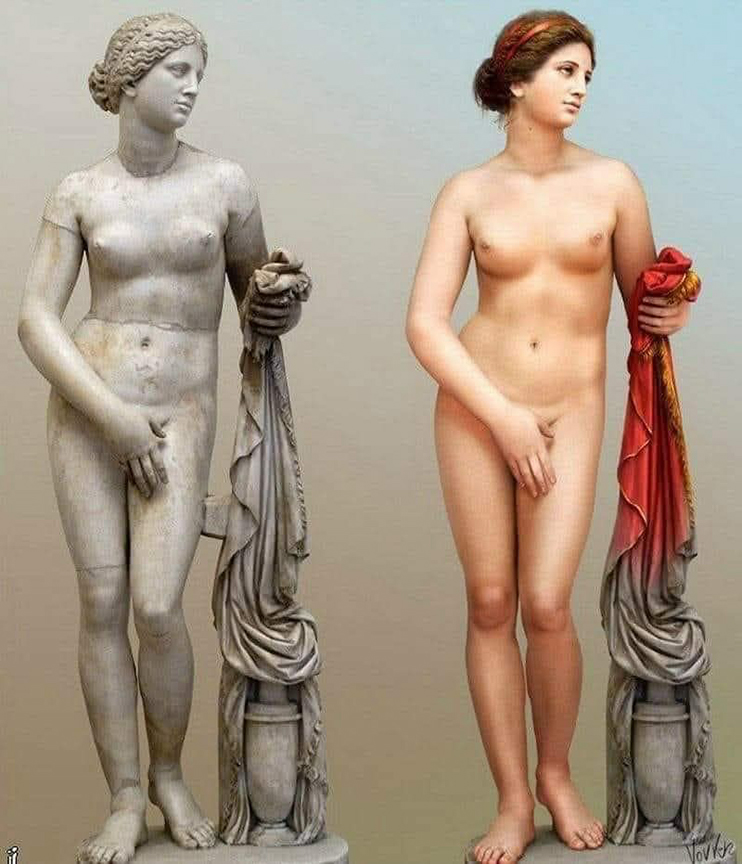
In 2025, working with models and doing remote shoots are the studio of Zoi Morgan in Den Haag, I began a series of shoots were the model posed in the manner of the ancient statue called the Aphrodite of Knidos. What follows is the story relates to that statue and why it was both revolutary and news classical ideal for nude female sculptures.
The Aphrodite of Knidos
This statue called The Aphrodite of Knidos (or Cnidus) was inspired by the most famous Greek sculpture of a goddess, Aphrodite. It was carved from fine marble by Praxiteles of Athens around the 4th century BC. it enjoyed great renown as the first devotional statue of a female goddess in the nude. It reported produced an immediate sensation when it was installed in a sacred precinct on the island of Knidos, and, centuries later, it inspired Roman artists to re-create the celebrated image.
Although the original Greek sculpture no longer exists, Roman statues inform us of its likely appearance. However, the function of these later Roman versions was fundamentally different from that of the earlier Greek work: what had once been an object of veneration among the Greeks became a favorite garden ornament for wealthy Romans.
The statue was one of the first life-sized representations of the nude female form in Greek history, displaying an alternative idea to male heroic nudity. Up until this point, Greek sculpture had been dominated by male nude figures. It was bought by the people of Knidos, one of most important cities of the West Anatolian shore (in Turkey). The earliest text to mention the Aphrodite is Pliny the Elder’s Natural History, which reports that Praxiteles carved two sculptures of Aphrodite, one clothed and one nude; the clothed one was bought by the people of Kos and the Knidians bought the nude one.
The statue was set up for cult worship in the Temple of Aphrodite at Knidos. It depicted the goddess Aphrodite as she prepared for the ritual bath that restored her purity, discarding her drapery with one hand, while modestly shielding herself with the other. The female nude appeared nearly three centuries after the earliest nude male counterparts in Greek sculpture, the kouros; the female kore figures were clothed. Previously nudity was a heroic uniform assigned only to men. This Aphrodite by Praxiteles established a canon for the proportions of the female nude. According to ancient sources, Praxiteles used the courtesan Phryne as the model.
The statue became so widely known and copied that in a humorous anecdote the goddess Aphrodite herself came to Knidos to see it. An epigram of Antipater of Sidon places a hypothetical question on the lips of the goddess herself: “Paris, Adonis, and Anchises saw me naked, Those
are all I know of, but how did Praxiteles contrive it?” She thought it was a perfect representation of her beauty. In its original form the statue was polychromed to appear lifelike.
Source: Wikimedia via Google; info collected and edited by Tom Cubbage on 10-01-2024